
Most ecommerce brands hit the same wall around their second year of paid growth. Spend increases, returns flatten, and diagnostics point at creative fatigue. The recommendation is always more variants.
The obstacle is always the same: a video costs several hundred dollars and a week to produce, so the team ships four a month, the algorithm exhausts them in ten days, and performance degrades on schedule.
The creative volume problem isn’t a strategy failure. It’s an arithmetic one, and it has recently become solvable in a way it wasn’t three years ago.
Creative Volume Is Now a Media Buying Variable
Platform auction mechanics have shifted meaningfully. Broad targeting and automated placement have transferred most optimisation work from audience selection to creative selection, which means the system needs a supply of distinct assets to test against.
Accounts feeding fresh creative consistently outperform accounts with better targeting and static assets. This is uncontroversial among experienced buyers and still under-resourced at most brands, because creative budgets were set when targeting did the heavy lifting.
The awkward truth is that a brand producing four assets monthly is not running a creative testing programme. It’s making ads and hoping. Genuine testing requires enough variants to isolate what’s working — the hook, the offer framing, the format — and four is nowhere near that threshold.
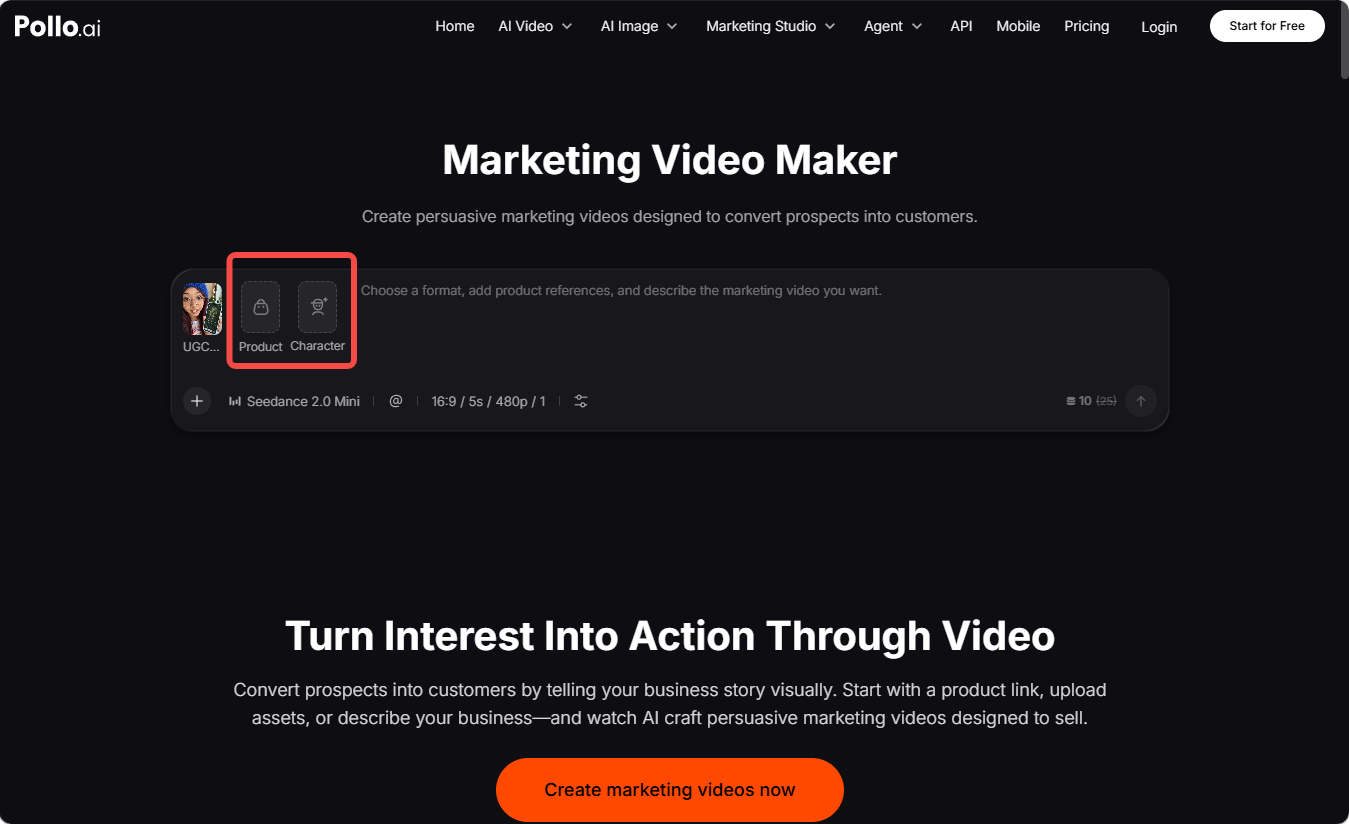
Closing the gap manually is impractical for most teams, which is why tools such as Pollo AI’s Marketing Video Maker have found traction with lean ecommerce operations. It works from material the store already maintains — the product listing, catalogue imagery, existing clips, campaign copy — and assembles them into finished promotional pieces with the persuasive structure built in, so a merchandiser without editing skills can produce shippable ad creative without commissioning anything. For a five-person team, that changes what a monthly creative calendar can realistically contain.
The Economics of Cheap Failure
Discussion of AI production usually centres on cost savings. That framing undersells what actually changes.
The real shift is that killing a bad concept stops being politically difficult. Under an agency model, every concept arrives carrying enough sunk cost that teams defend it, extend the test window and rationalise mediocre numbers. Under a low-cost production model, an underperforming angle gets switched off on day three without discussion.
That single behavioural change tends to move blended acquisition costs more than any individual creative improvement. Brands aren’t winning because their AI-produced ads outperform agency ads — often they don’t, individually. They’re winning because they test twelve angles instead of two and find the one that works.
Where Message Testing Beats Asset Testing
A common mistake when creative volume increases is testing assets rather than messages. Forty videos that all say the same thing in slightly different visual language teach you nothing except which edit people prefer.
Build a message matrix first. For a skincare brand that might mean testing ingredient credibility against routine simplicity against value-per-use, each with its own hook. Then produce two or three executions per message. Results become interpretable, and the winning message informs everything downstream — landing page copy, email subject lines, retention flows.
This is where product video ad creative starts functioning as market research rather than just media fuel, which is a considerably better return on the same production spend.
An Alternative Path for Narrative-Led Brands
Not every category wins on volume. Considered-purchase products, higher price points and brands built on storytelling often need fewer, better-crafted pieces, and template-guided systems suit that shape of work.

DeeVid AI operates in that territory. Its producer-led workflow moves users through planning, generation and refinement across a library of more than a hundred templates, keeping character appearance and visual treatment stable across multi-scene sequences. It matches individual shots to the most appropriate underlying model, handles keyframe-based motion completion, and includes studio-quality voice synthesis with generated soundtracks. It also supports structured A/B variant production and localisation across a wide range of languages with accurate lip and expression sync.
For a furniture brand producing a six-scene branded film, that control is worth the additional setup. For a supplement brand testing twenty hooks this month, it’s overhead.
Running a Monthly Creative Sprint Without Extra Headcount
Audit Which SKUs Deserve Video at All
Not every product justifies motion. Pull last quarter’s data and identify the items with meaningful margin, sufficient inventory depth and a demonstrable visual quality — something that moves, transforms, assembles or shows scale. Products that photograph perfectly well and have no dynamic property rarely earn back the effort. Most catalogues have between eight and fifteen genuine video candidates, not two hundred.
Write the Message Matrix Before Producing Anything
Spend the first session writing hooks, not making videos. Four distinct messages, three hook variations each, give twelve testable concepts on a single page. Reviewing them in text form takes twenty minutes and eliminates the weak ones before any production time is spent — the cheapest filtering stage available to you.
Batch Production in One Working Session
Produce the full month’s assets in one sitting rather than weekly. Feeding the listing URL and existing product imagery into Pollo AI’s Marketing Video Maker generates the base pieces, and each one exports directly into the placement dimensions each channel requires, so a single concept covers Reels, Shorts, in-feed and story placements without separate builds. Batching also enforces consistency, because everything is produced against the same brief on the same day.
Read Results at the Message Level
When analysing performance, aggregate by message rather than by individual asset. Three executions of the same claim outperforming everything else is a signal about positioning. One asset outperforming is usually noise. Feed the winning message into your landing pages and email programme, since a claim that converts on paid traffic almost always converts on owned channels too.
The Structural Advantage Is Speed of Learning
The brands pulling ahead in paid social right now aren’t the ones with the best creative. They’re the ones with the shortest loop between hypothesis and evidence.
That loop used to be measured in weeks and constrained by production calendars. Compressing it to days changes what a small team can accomplish against a larger competitor whose creative approvals take a fortnight.
Whether a brand routes its narrative work through DeeVid AI or builds its testing volume around catalogue-driven generation, the operational discipline matters more than the tooling. Volume without a message framework is just noise at scale, and platforms will happily charge you to distribute it.
