
The best power supplies for gaming PCs in 2026.
A good power supply isn’t going to increase your frame rate, but it is one of the most important components in your gaming PC.
And choosing the right PSU has become a little more complicated over the last few years.
Modern high-end graphics cards can pull significantly more power than previous generations, and newer power supplies have been updated to better handle those loads.
For a new gaming PC in 2026, we’d generally look for an ATX 3.1 power supply with PCIe 5.1 support and a native 12V-2×6 connection if you’re using a graphics card that requires one.
That doesn’t mean an older high-quality power supply suddenly became useless.
But if you’re buying a PSU from scratch, there’s little reason not to take advantage of the newer standards—especially if you expect to keep the power supply through several future GPU upgrades.
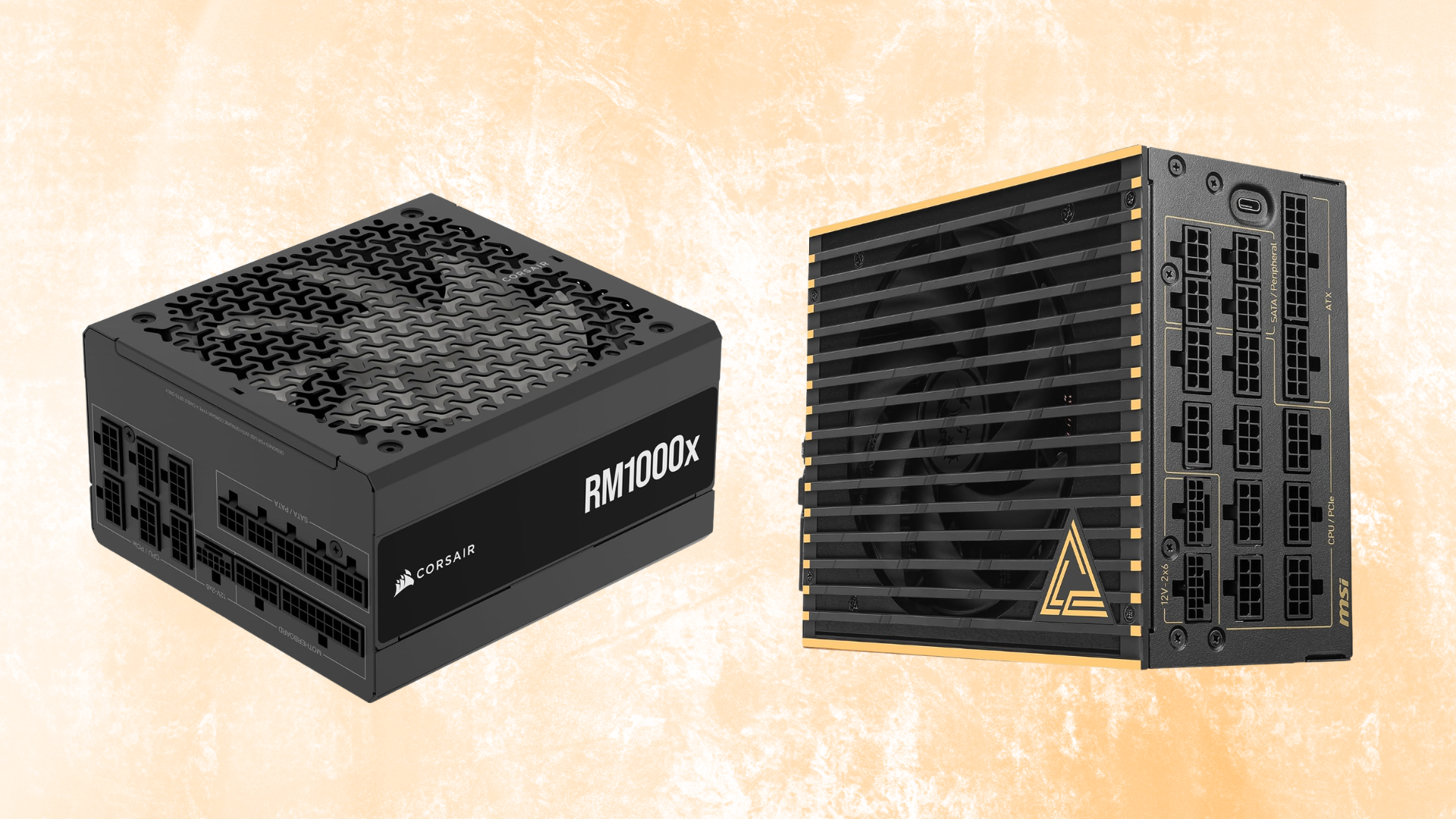
For most high-end gaming PCs, our favorite option is Corsair’s RM1000x.
It gives you 1000 watts of capacity, ATX 3.1 compliance, a native 12V-2×6 connection, fully modular cabling, excellent efficiency, a 140mm fluid-dynamic-bearing fan, and a 10-year warranty.
And 1000 watts provides enough headroom for a very powerful single-GPU gaming system without moving into the extreme cost and size of 1300W-1600W units.
If you’re putting together something considerably more demanding, MSI’s MEG Ai1600T PCIE5 is the option we’d step up to.
Its 1600W capacity, dual native 12V-2×6 connections, Titanium-level efficiency, digital monitoring capabilities, and 12-year warranty make it better suited to extreme builds than normal gaming PCs.
The be quiet! Dark Power 14 provides another premium alternative, particularly if efficiency and quiet operation are high priorities.
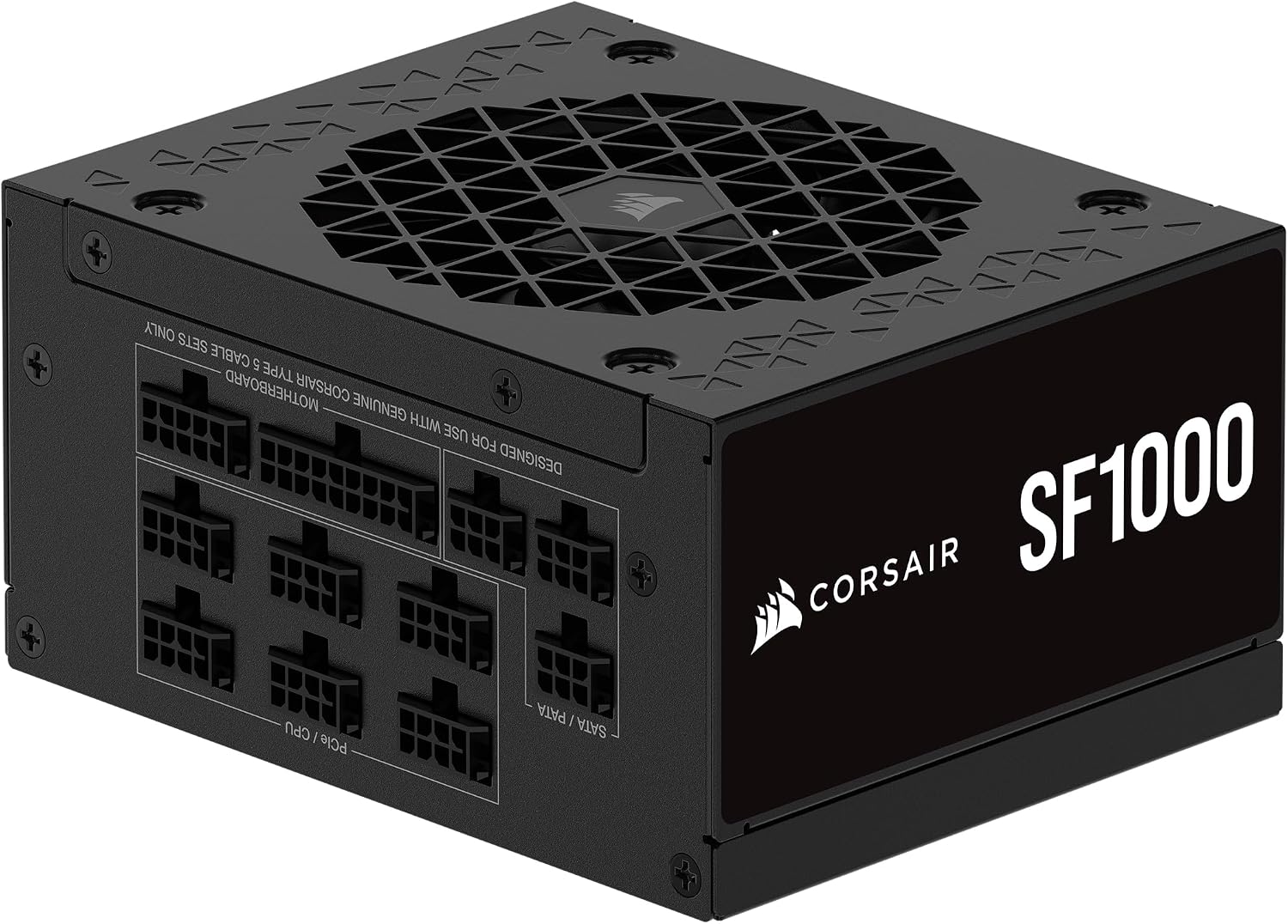
For small-form-factor systems, Corsair’s SF1000 manages to deliver an enormous 1000 watts from a true SFX chassis while retaining ATX 3.1 support and an 80 PLUS Platinum rating.
You don’t have to spend anywhere near that much, though.
MSI’s MAG A850GL PCIE5 is our favorite value option and gives most gaming PCs all the power they’ll realistically need.
And for lower-cost builds, the MAG A650BN PCIE5 III gets you a 650W ATX 3.1 power supply with a native 12V-2×6 connection without forcing you to spend a large portion of your build budget on the PSU.
Also Read: How to Choose A Power Supply for Your Gaming PC
Watch: What to Look for in A Power Supply
Watch our Beginner’s Guide to Choosing a PSU below, or on our YouTube channel.
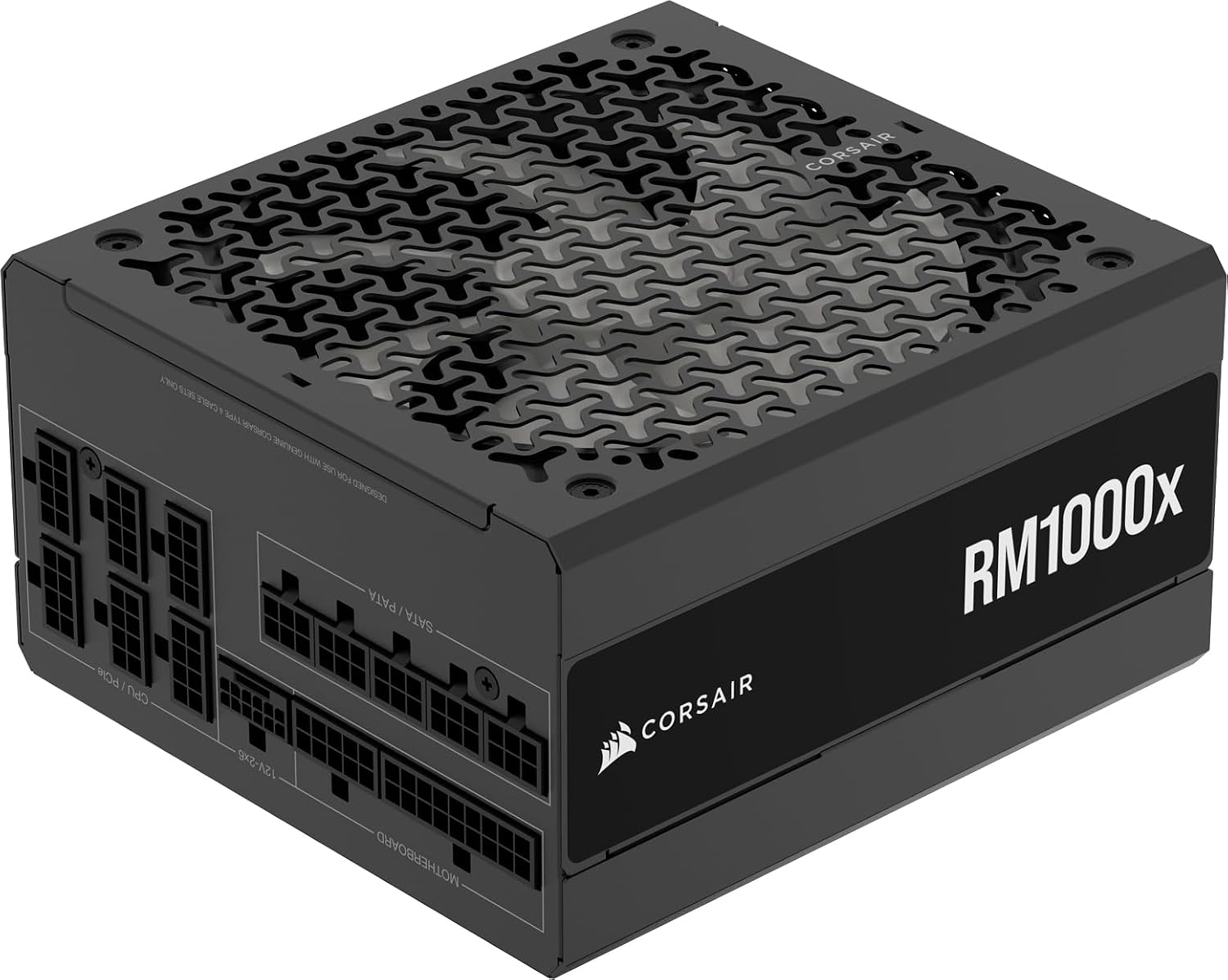
Corsair RM1000x
The best power supply overall.
Tech Specs
- WATTAGE: 1000W
- EFFICIENCY: Cybenetics Gold
- STANDARD: ATX 3.1 / PCIe 5.1
- GPU CABLE: Native 12V-2×6
- MODULAR: Fully modular
- WARRANTY: 10 years
Pros & Cons
- Excellent capacity for a high-end gaming PC
- Native 600W 12V-2×6 connection
- Quiet 140mm FDB fan with Zero RPM operation
- Fully modular cables and 10-year warranty
- 1000W is more capacity than most mid-range PCs need
Corsair RM1000x Overview
If we were putting together a powerful gaming PC today and wanted one power supply that made sense for both the current system and future upgrades, we’d start with Corsair’s RM1000x.
Specifically, we’re recommending the newer ATX 3.1 version of the RM1000x.
That distinction is important because Corsair has sold several generations of RMx power supplies.
The current version brings the series up to date with ATX 3.1 and PCIe 5.1 support and includes a native 12V-2×6 GPU connection.
The included 12V-2×6 cable can deliver up to 600 watts, making it appropriate for modern high-end graphics cards that use the newer 16-pin power connection.
That gives you a much cleaner solution than running several conventional PCIe power cables into an adapter.
The 1000W capacity is also a good fit for where high-end gaming systems have ended up.
You absolutely do not need a 1000W power supply for every gaming PC.
A more efficient mid-range system could operate perfectly well from a quality 650W, 750W, or 850W unit.
But once you’re combining a flagship-class graphics card with a high-end processor, several drives, large numbers of fans, liquid cooling, and other accessories, the additional headroom becomes useful.
A 1000W unit can also make sense if you intend to keep your PSU for several generations of hardware.
Unlike a CPU or graphics card, a good power supply can easily survive several major PC upgrades.
The RM1000x is fully modular as well.
You only need to connect the cables your particular build requires, which makes cable management considerably easier than it would be with a non-modular power supply.
Cooling comes from a 140mm fluid-dynamic-bearing fan.
Corsair’s Zero RPM functionality allows the fan to remain stopped under sufficiently light loads, while a manual fan-control knob on the rear gives you additional control over its behavior.
Corsair rates the current RMx platform at Cybenetics Gold efficiency and backs the unit with a 10-year warranty.
There are more efficient power supplies.
There are also significantly more powerful power supplies.
But neither necessarily makes more sense for the average high-end gaming PC.
What makes the RM1000x our favorite overall option is its balance.
You get plenty of capacity, modern GPU connectivity, the newer ATX standard, modular cabling, quiet cooling, a long warranty, and enough power to accommodate hardware far beyond what most gaming PCs actually use.
For a new high-end build, that’s exactly what we’d want.
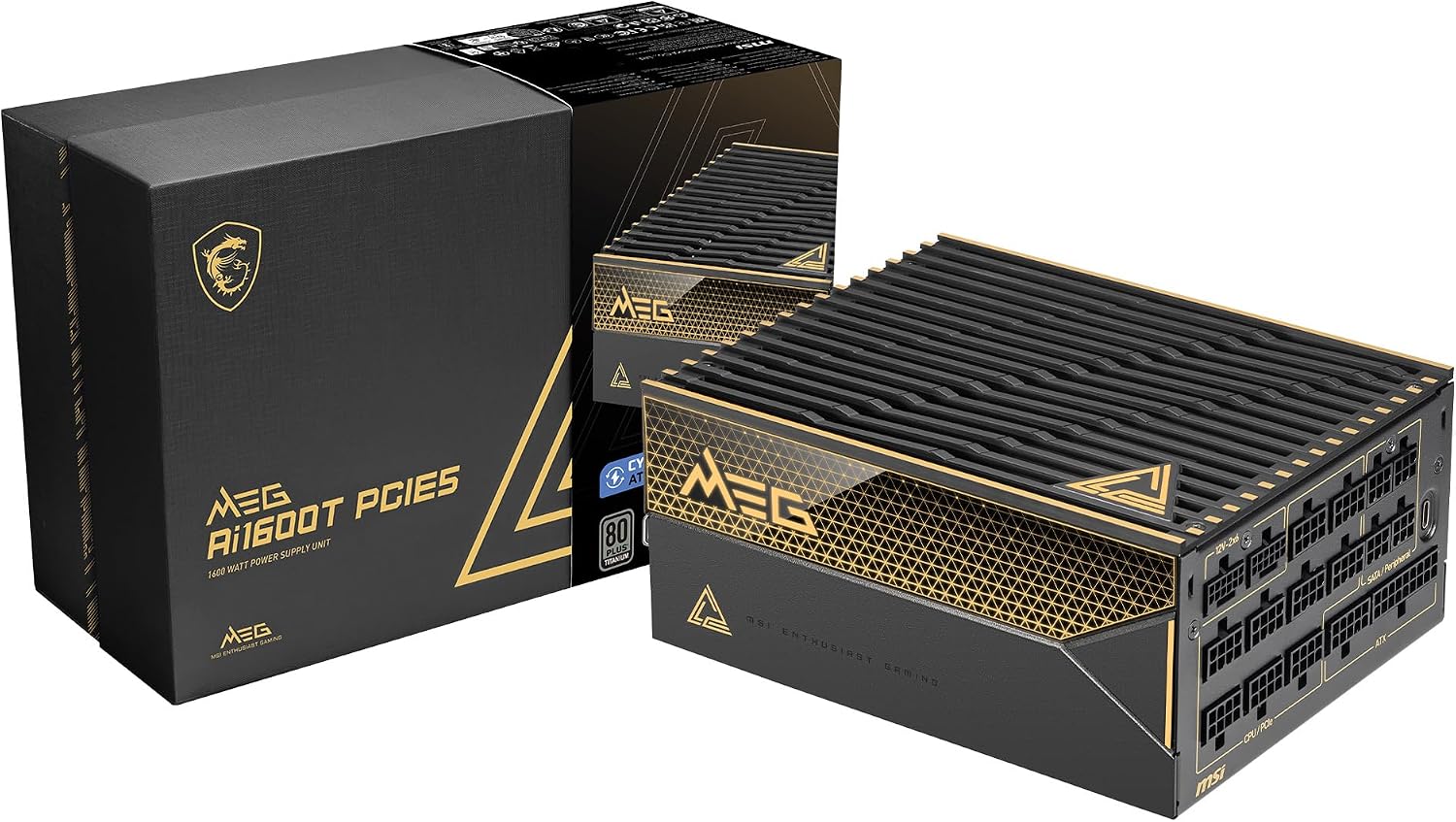
MSI MEG Ai1600T PCIE5
The best PSU for an extreme gaming PC.
Tech Specs
- WATTAGE: 1600W
- EFFICIENCY: Titanium
- STANDARD: ATX 3.1 / PCIe 5.1
- GPU CABLES: 2x native 12V-2×6
- MODULAR: Fully modular
- WARRANTY: 12 years
Pros & Cons
- Enormous 1600W capacity
- Dual native 12V-2×6 connections
- Titanium efficiency certifications
- Digital monitoring and 12-year warranty
- Wildly unnecessary for a normal gaming PC
MSI MEG Ai1600T PCIE5 Overview
Most people should not buy a 1600W power supply.
If your gaming PC contains one mid-range or high-end graphics card and a conventional desktop processor, there are far less expensive options that will work perfectly well.
The MSI MEG Ai1600T PCIE5 is for the builds that aren’t particularly concerned with being sensible.
Its headline specification is obviously the 1600W capacity.
That’s enough power for extremely demanding combinations of high-end CPUs, flagship graphics hardware, extensive cooling, storage, and additional expansion hardware.
But raw wattage isn’t the only reason to consider it.
The Ai1600T is an ATX 3.1 and PCIe 5.1-ready platform with two native 12V-2×6 connections.
That gives the unit considerably more flexibility for unusually demanding hardware configurations than you’d get from a conventional 850W or 1000W PSU.
It’s also designed to tolerate the large, short-duration power excursions that modern hardware can generate.
That matters because a system’s average power consumption doesn’t tell the entire story.
A graphics card can demand substantially more power for a very short period than its normal sustained consumption would suggest.
Modern ATX specifications take those transient loads into account.
Efficiency is another major part of the Ai1600T’s appeal.
MSI lists Titanium certification from 80 PLUS, Cybenetics, and PPLP.
In a system capable of pulling an enormous amount of power, reducing the amount of energy lost as heat becomes increasingly useful.
The unit also uses 105°C-rated Japanese capacitors and a fully digital design with a control MCU.
MSI Center can be used for monitoring and fan-related controls, giving enthusiasts more visibility into the power supply than they’d get with a completely conventional unit.
Cooling is handled by a 135mm double-ball-bearing fan, and MSI provides a Zero Fan mode that can shut the fan off at lighter loads.
And whereas most premium power supplies carry 10-year warranties, MSI backs the Ai1600T for 12 years.
That makes sense for a component this expensive.
If you’re spending this much on a PSU, you’d reasonably expect to carry it through several generations of hardware.
For the vast majority of gaming PCs, we’d still buy the RM1000x, A850GL, or another smaller unit and put the savings toward components that actually improve gaming performance.
But if you’re deliberately building an extreme system and want an equally extreme power supply, the Ai1600T is one of the most complete options available.
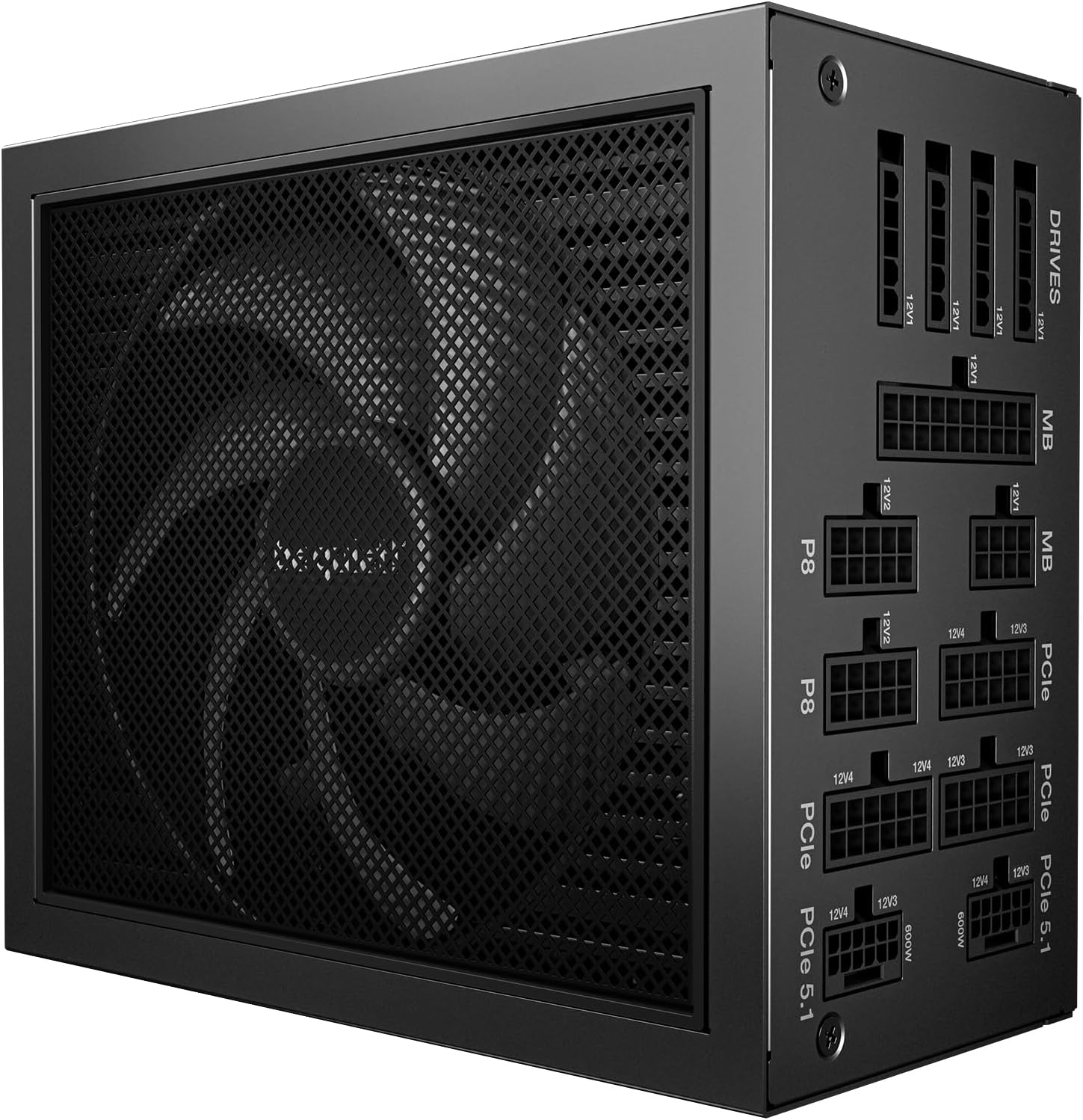
be quiet! Dark Power 14
The best premium power supply.
Tech Specs
- CAPACITIES: 1200 / 1000 / 850W
- EFFICIENCY: 80 PLUS Titanium
- STANDARD: ATX 3.1 / PCIe 5.1
- GPU CABLES: 2x 12V-2×6 on 1200W
- MODULAR: Fully modular
- WARRANTY: 10 years
Pros & Cons
- 80 PLUS and Cybenetics Titanium efficiency
- Selectable active or semi-passive cooling
- Single-rail or multi-rail operating modes
- Premium sleeved modular cables
- Costs considerably more than a good Gold-rated PSU
be quiet! Dark Power 14 Overview
There is a point where buying a more expensive power supply stops being about getting something you need and starts becoming about getting something better than you need.
The be quiet! Dark Power 14 sits firmly in that category.
For a normal gaming system, a good 80 PLUS Gold PSU will do the job for considerably less money.
But if you’re putting together a premium build and want efficiency, low noise, modern connectivity, and high-end construction to match the rest of the system, the Dark Power 14 makes a lot of sense.
We’re specifically linking to the 1200W model, although be quiet! also offers 1000W and 850W versions.
The 1200W unit is certified for both 80 PLUS Titanium and Cybenetics Titanium efficiency.
Higher efficiency means less of the power coming from the wall is wasted as heat inside the power supply.
The practical difference in electricity cost between Gold and Titanium isn’t necessarily enough to justify buying the Dark Power 14 by itself.
But producing less waste heat can also help with cooling and noise, and those considerations become more meaningful as system power consumption increases.
be quiet! has put particular emphasis on cooling.
The Dark Power 14 uses one of the company’s Silent Wings fans and allows you to choose between active and semi-passive operation with a button on the rear of the PSU.
In active mode, the fan continuously runs at a low speed.
In semi-passive mode, it can stop at low loads and begin spinning when additional cooling is necessary.
That’s a nice feature because there isn’t universal agreement on which approach is better.
Some users want the PSU to remain completely silent whenever possible.
Others prefer continuous low-speed airflow rather than repeatedly stopping and starting the fan.
The Dark Power 14 lets you choose.
The 1200W model also gives you two native 12V-2×6 cables alongside conventional PCIe 6+2-pin connections.
That provides excellent compatibility with both newer and older high-end graphics hardware.
Another enthusiast-oriented feature is the ability to switch between the PSU’s default multi-rail operation and a high-powered single-rail configuration.
Most builders will never need to touch this.
But for heavily overclocked systems, the additional control can be useful.
Inside, be quiet! uses Japanese capacitors rated for operation at 105°C, and the fully modular sleeved cables help give a premium build a cleaner appearance.
A 10-year warranty rounds out the package.
Again, this isn’t the PSU we’d buy for a price-to-performance-oriented PC.
Spending extra money on a Titanium PSU isn’t going to make your games run faster.
But if you’ve already spent heavily on the CPU, graphics card, cooling, case, and everything else and want an equally premium PSU, the Dark Power 14 is an excellent choice.
Corsair SF1000
The best SFX power supply.
Tech Specs
- WATTAGE: 1000W
- FORM: SFX
- EFFICIENCY: 80 PLUS Platinum
- STANDARD: ATX 3.1 / PCIe 5.1
- MODULAR: Fully modular
- WARRANTY: 7 years
Pros & Cons
- 1000W capacity in a true SFX enclosure
- 80 PLUS and Cybenetics Platinum efficiency
- Native PCIe 5.1 12V-2×6 cable
- Fully modular Type-5 cables
- Much more expensive than comparable ATX power supplies
Corsair SF1000 Overview
Building a small gaming PC used to mean accepting significant restrictions on how powerful the system could be.
That’s much less true today.
Modern Mini-ITX cases can accommodate enormous graphics cards, high-end CPUs, and surprisingly capable liquid-cooling configurations.
But fitting all of that hardware into a small chassis requires an equally compact power supply.
Corsair’s SF1000 is our favorite solution.
The most impressive specification is the combination of size and capacity.
This is a true SFX power supply—not a longer SFX-L unit—yet it can deliver 1000 watts.
That gives you enough power to build the kind of high-end small-form-factor system that would have required a much larger enclosure in the past.
It’s also fully up to date electrically.
The current SF1000 is ATX 3.1 compliant, supports PCIe 5.1, and includes a 12V-2×6 GPU cable.
So choosing a compact PSU doesn’t mean giving up the modern GPU connection you’d get from a larger premium ATX model.
Efficiency is particularly useful in a small case.
The SF1000 carries both 80 PLUS Platinum and Cybenetics Platinum efficiency ratings.
An SFF enclosure typically has less air volume and less room to separate heat-producing components.
Reducing the amount of waste heat generated inside the PSU is therefore especially welcome.
Corsair cools the unit with a 92mm fluid-dynamic-bearing fan.
Zero RPM operation allows the fan to stop under sufficiently light loads.
The smaller fan is one of the unavoidable consequences of the SFX form factor, but Corsair’s high efficiency helps reduce the amount of cooling the PSU requires in the first place.
The unit is fully modular and uses Corsair’s compact Type-5 Micro-Fit connections on the PSU side.
That matters in an ITX case.
Trying to stuff unused cables into an already crowded small-form-factor enclosure is exactly the kind of problem you want to avoid.
Corsair also uses 105°C-rated Japanese electrolytic capacitors and backs the SF1000 with a seven-year warranty.
There are cheaper SFX units and lower-wattage models that will make more sense for less demanding systems.
In fact, Corsair also offers the current SF platform in 750W and 850W capacities.
But the SF1000 is the model we’d choose if we’re already going through the expense and planning required to build a genuinely high-end Mini-ITX gaming PC.
You get ATX-class power capability without having to make room for an ATX power supply.
MSI MAG A850GL PCIE5
The best-value power supply.
Tech Specs
- WATTAGE: 850W
- EFFICIENCY: 80 PLUS Gold
- STANDARD: ATX 3.1 / PCIe 5.1
- GPU CABLE: Native 12V-2×6
- MODULAR: Fully modular
- WARRANTY: 10 years
Pros & Cons
- Excellent combination of price and capacity
- ATX 3.1 with native modern GPU connection
- Fully modular design
- Compact 140mm-deep chassis and 10-year warranty
- 1000W+ units make more sense for the most power-hungry flagship builds
MSI MAG A850GL PCIE5 Overview
The sweet spot for a gaming power supply isn’t necessarily the highest wattage or efficiency rating you can afford.
It’s getting enough power and the features your system actually needs without spending money that would be better used elsewhere.
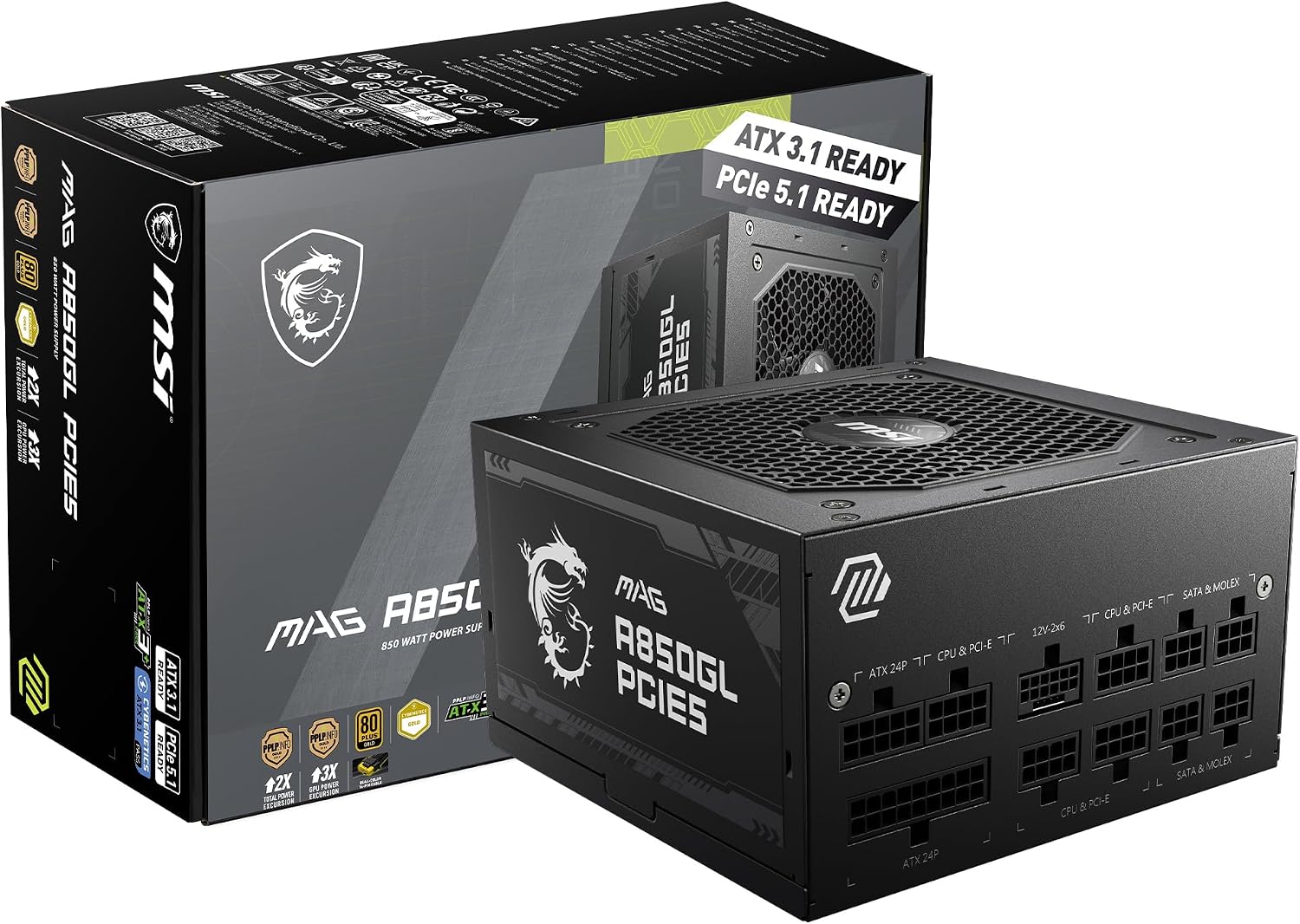
That’s why we like MSI’s MAG A850GL PCIE5 so much.
Its 850W capacity is enough for a huge range of modern gaming PCs.
For a system built around a mid-range or high-end graphics card, 850 watts gives you considerably more flexibility than a basic 550W or 650W unit without pushing you into the price range of premium 1000W-1600W power supplies.
The A850GL is also a modern ATX 3.1 platform.
It supports PCIe 5.1 and provides a native 16-pin GPU cable capable of supplying up to 600W on compatible hardware.
That makes it a much better option for a new build than saving a small amount of money on an older PSU and immediately having to depend on a graphics-card power adapter.
MSI uses a dual-color design on the 16-pin cable to make it easier to visually confirm that the connection has been inserted properly.
The unit is fully modular as well.
You can leave unused SATA, PCIe, and peripheral cables in the box rather than trying to hide them inside your case.
Another useful feature is its physical size.
At approximately 140mm deep, the A850GL is relatively compact for a high-capacity ATX power supply.
That’s useful even if you aren’t building a small PC.
Some cases place drive cages, cable-routing channels, or other components immediately in front of the PSU, and reducing the PSU’s depth gives you additional room to work.
Efficiency is rated at 80 PLUS Gold, and MSI uses a 120mm fluid-dynamic-bearing fan for cooling.
You also get the standard protection features we’d expect from a modern PSU, including over-voltage, over-current, over-power, over-temperature, short-circuit, and under-voltage protections.
MSI backs the A850GL with a 10-year warranty.
That warranty is especially important in this price category.
A value PSU shouldn’t mean buying something disposable that you’ll have to replace when you perform your next upgrade.
There are systems where we’d choose something larger.
If you’re installing one of the most power-hungry flagship GPUs available alongside a high-end processor, we’d seriously consider moving to a 1000W or larger PSU based on the hardware manufacturer’s recommendation.
But that isn’t what most gaming PCs look like.
For the much larger group of builders putting together a strong mainstream or high-end gaming PC, the A850GL gives you nearly everything we’d want without charging a premium for features you probably don’t need.
MSI MAG A650BN PCIE5 III
The best budget power supply.
Tech Specs
- WATTAGE: 650W
- EFFICIENCY: 80 PLUS Bronze
- STANDARD: ATX 3.1 / PCIe 5.1
- GPU CABLE: Native 12V-2×6
- MODULAR: Non-modular
- WARRANTY: 5 years
Pros & Cons
- Very affordable for a modern ATX 3.1 PSU
- Native 12V-2×6 connection
- Compact 140mm-deep design
- Five-year warranty
- Non-modular and not intended for power-hungry flagship builds
MSI MAG A650BN PCIE5 III Overview
A budget gaming PC doesn’t need a 1000W power supply.
In fact, overspending on your PSU can actively make the finished gaming PC slower if doing so forces you to reduce your graphics-card or processor budget.
The goal is to buy enough power from a reputable platform while avoiding the questionable no-name units that often populate the lowest end of the PSU market.
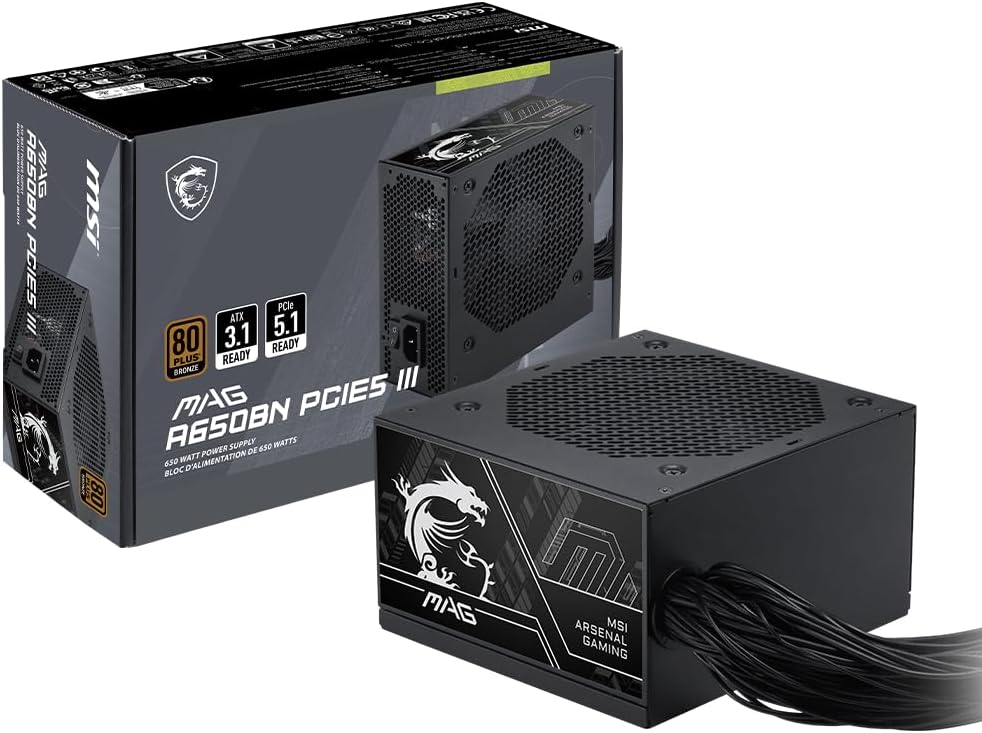
MSI’s MAG A650BN PCIE5 III is one of the more interesting budget options available because it brings several modern features into a relatively inexpensive 650W unit.
Most importantly, it is ATX 3.1 ready and supports PCIe 5.1.
You also get a native 12V-2×6 GPU connection.
MSI rates that connection for up to 300W on this particular model.
That’s an important detail.
The presence of a 12V-2×6 connector doesn’t magically turn a 650W budget PSU into something we’d pair with the most power-hungry flagship graphics card available.
You still need to choose the PSU capacity according to your complete system and follow the graphics-card manufacturer’s recommended power-supply rating.
For the lower-power graphics cards you’d realistically use in a budget or mid-range gaming PC, though, having the modern connector gives you useful flexibility.
The A650BN PCIE5 III also includes two conventional PCIe 6+2-pin connections, so you aren’t restricted to graphics cards that use the newer connector.
Efficiency is rated at 80 PLUS Bronze.
That’s a step down from the Gold, Platinum, and Titanium units elsewhere in this guide, but that’s perfectly reasonable at this price point.
An efficiency certification also shouldn’t be confused with an overall PSU quality rating.
Its primary purpose is to describe how efficiently the PSU converts AC power from the wall into the DC power your components use.
The A650BN uses a DC-to-DC design, active PFC, and includes protection against over-voltage, over-current, short circuits, over-power conditions, and under-voltage conditions.
Cooling is handled by a 120mm fan.
This is also a non-modular power supply.
Every cable is permanently attached, whether you use it or not.
That makes cable management less convenient than it would be with the A850GL or RM1000x.
But this is exactly the kind of compromise we’re willing to accept from a budget PSU.
Modular cabling is convenient.
It doesn’t make your graphics card faster.
If choosing a non-modular PSU allows you to put another $30-$50 into your GPU, that’s generally the trade we’d make in a lower-cost gaming system.
MSI also backs the unit with a five-year warranty.
If you’re building a powerful enthusiast PC, we’d spend more and move up this list.
But for an affordable system that simply needs a modern, appropriately sized PSU from an established manufacturer, the A650BN PCIE5 III is a compelling option.
Which power supply should you choose?
For most high-end gaming PCs, we’d choose the Corsair RM1000x.
Its 1000W capacity gives you plenty of breathing room for powerful modern components, while ATX 3.1 support and the native 12V-2×6 connection make it a good fit for newer graphics cards.
The fully modular cables, quiet 140mm fan, Gold-level efficiency, and 10-year warranty round out an excellent all-around package.
You don’t automatically need 1000 watts, though.
For a more typical gaming PC, the MSI MAG A850GL PCIE5 is probably the better value.
Its 850W capacity is plenty for a broad range of modern systems, and you’re still getting ATX 3.1, PCIe 5.1, a native modern GPU cable, fully modular cabling, and a 10-year warranty.
At the other extreme, the MSI MEG Ai1600T PCIE5 exists for systems where 1000 watts somehow isn’t enough.
The overwhelming majority of gamers shouldn’t spend that much money on a power supply.
But its 1600W capacity, dual 12V-2×6 connectors, Titanium efficiency, digital controls, and 12-year warranty are useful if you’re building an unusually demanding enthusiast or workstation-class system.
The be quiet! Dark Power 14 is another premium alternative.
We’d choose it over the RM1000x if your priorities lean heavily toward Titanium efficiency, low-noise operation, premium cables, and enthusiast features such as selectable active/semi-passive cooling and switchable rail operation.
If you’re building a Mini-ITX system, the Corsair SF1000 is the obvious standout.
Putting 1000 watts, Platinum efficiency, ATX 3.1 support, and a native 12V-2×6 connection into a true SFX enclosure makes it possible to build an extremely powerful PC without using an ATX power supply.
And if you’re trying to keep the total system cost as low as possible, we’d look at MSI’s MAG A650BN PCIE5 III.
It gives up modular cabling and carries a lower Bronze efficiency rating, but its 650W capacity and newer ATX 3.1 connectivity make it far more appropriate for a modern budget gaming PC than the questionable bargain-bin power supplies we’d strongly recommend avoiding.
Ultimately, start with your graphics card manufacturer’s PSU recommendation, account for the rest of your hardware, and then buy a quality unit with some reasonable headroom.
There is no benefit in buying 1600 watts when your entire PC only requires 500.
But there is also very little sense in spending thousands of dollars on high-end components and then choosing the cheapest PSU capable of turning them on.
Frequently Asked Questions
What is the best power supply for gaming in 2026?
For a high-end gaming PC, our favorite overall option is the Corsair RM1000x.
The current RM1000x provides 1000 watts of capacity, ATX 3.1 compliance, PCIe 5.1 support, a native 12V-2×6 GPU connection, fully modular cables, Gold-level efficiency, and a 10-year warranty.
However, that doesn’t make it the best choice for every gaming PC.
For a less power-hungry system, MSI’s MAG A850GL PCIE5 offers many of the same important features with an 850W capacity and a lower price.
For budget gaming PCs, the MAG A650BN PCIE5 III is a more appropriate 650W alternative.
And if you’re building a small-form-factor system that requires an SFX power supply, we’d choose Corsair’s SF1000.
How many watts do you need for a gaming PC?
It depends primarily on your graphics card and processor.
A lower-power gaming PC may only need a quality 550W-650W PSU.
A more powerful mid-range or high-end system will often make more sense with a 750W-850W unit.
At the flagship end of the market, 1000W or more can become appropriate.
For example, NVIDIA specifies a 1000W minimum system power supply for its reference RTX 5090 configuration.
But you shouldn’t choose PSU wattage solely by putting your system into one of those broad categories.
Look up the PSU recommendation for the exact graphics card you’re buying.
An overclocked partner-model GPU can have different requirements than a reference design, and the processor and rest of the system matter as well.
We’d generally prefer to have some unused capacity rather than selecting a PSU that will operate close to its maximum output every time the system is heavily loaded.
Is a 1000W power supply overkill?
For a lot of gaming PCs, yes.
If you’re building a system around a relatively efficient CPU and mid-range graphics card, there is very little reason to pay extra for a 1000W power supply.
A quality 650W, 750W, or 850W unit can be a better use of your budget.
A 1000W PSU becomes more attractive when you’re using a flagship-class graphics card, combining very power-hungry components, heavily overclocking your system, or buying additional capacity for future upgrades.
The PSU won’t force 1000 watts into your PC.
Your components only draw the amount of power they require.
So there is nothing inherently wrong with having more PSU capacity than you need.
The problem is simply that you’re paying for capacity that might never be used.
What is ATX 3.1?
ATX 3.1 is a newer power-supply specification designed with the requirements of modern PC hardware in mind.
One of the important areas addressed by newer ATX specifications is transient power consumption.
Modern graphics cards can briefly demand substantially more power than their normal sustained consumption, and compliant power supplies are designed to tolerate those excursions.
ATX 3.1 is also closely associated with the newer PCIe 5.1 12V-2×6 graphics-card connection.
If you’re buying a new PSU in 2026, we’d generally choose an ATX 3.1 model when the price difference is reasonable.
That doesn’t mean every older ATX power supply should immediately be replaced.
A high-quality older unit with sufficient capacity and the appropriate cabling may continue to work perfectly well.
ATX 3.1 simply gives a new build a more current foundation.
What is a 12V-2×6 connector?
12V-2×6 is the newer 16-pin high-power connection used by many modern graphics cards.
It succeeds the earlier 12VHPWR connection and is part of the newer PCIe power specification.
Depending on the PSU and cable, a 12V-2×6 connection can support as much as 600 watts of GPU power through a single cable.
That dramatically reduces the amount of cabling required compared with supplying the same amount of power through several conventional 8-pin PCIe connections.
Not every 12V-2×6 cable is rated for 600W, though.
The MSI MAG A650BN PCIE5 III in this guide, for example, provides a native 12V-2×6 connection rated for 300W.
Always check the capabilities of the particular PSU and cable you’re using.
Is 12V-2×6 the same as 12VHPWR?
They’re closely related, but they aren’t identical.
12V-2×6 is the revised version of the high-power 16-pin GPU connector originally introduced as 12VHPWR.
One of the key physical changes involves the connector’s sense pins, helping ensure the connection is properly seated before the graphics card is permitted to request its highest power levels.
For someone buying a new power supply today, we’d prefer a current ATX 3.1 unit with native 12V-2×6 support over going out of our way to buy an older design.
Regardless of which connector you’re using, make sure it is fully inserted and avoid sharply bending or putting excessive sideways pressure on the cable immediately next to the connector.
Is 80 PLUS Gold good enough for a gaming PC?
Absolutely.
An 80 PLUS Gold power supply can be an excellent choice for anything from a modest gaming system to an extremely powerful high-end PC.
You do not need Platinum or Titanium efficiency to build a reliable gaming computer.
And it’s important to understand what the rating actually tells you.
80 PLUS is an efficiency certification.
A higher rating indicates that less energy is lost when the PSU converts the AC power from your outlet into the DC power used by your computer.
It is not, by itself, a comprehensive measure of build quality, electrical performance, reliability, noise, or component quality.
There are excellent Gold-rated power supplies and mediocre power supplies with efficiency certifications.
That’s why we’d evaluate the complete PSU rather than buying solely based on the badge printed on its box.
Also Read: 80 PLUS Bronze vs Gold vs Platinum vs Titanium: Which PSU Rating do You Need?
Is an 80 PLUS Platinum or Titanium PSU worth it?
Sometimes, but most gaming PCs don’t need one.
Platinum and Titanium power supplies reduce the amount of electricity lost during power conversion compared with lower efficiency tiers.
That means less wasted electricity and less heat generated inside the PSU.
Those advantages become more meaningful in systems that consume large amounts of power for long periods.
But the price difference between a good Gold PSU and a premium Titanium model can be substantial.
If you have a fixed gaming-PC budget, spending an additional $100 on a Titanium PSU while reducing your GPU budget by the same amount would usually be a poor trade.
We’d buy the high-efficiency unit after the rest of the system already contains the CPU and graphics card we want.
Should you get a modular power supply?
We prefer fully modular power supplies, but they aren’t required.
A fully modular PSU lets you disconnect every removable power cable from the unit.
That means you only install the cables your particular system needs.
A non-modular power supply permanently attaches its cables to the PSU.
Any cables you don’t use still need to be hidden somewhere inside the case.
Modularity therefore makes installation and cable management easier, particularly in smaller cases.
It doesn’t improve gaming performance or make the PSU inherently more reliable, though.
For a budget gaming PC, choosing a good non-modular PSU and using the savings toward a better graphics card can make perfect sense.
Also Read: What is A Modular Power Supply? Modular vs Non-Modular PSUs
Is an SFX power supply as good as an ATX power supply?
It can be.
SFX describes the physical form factor rather than the quality of the power supply.
Modern premium SFX units can deliver extremely high amounts of power and provide the same kinds of efficiency ratings, modular cabling, protection features, and modern GPU connections you’ll find on ATX models.
Corsair’s SF1000 is a good example.
It delivers 1000 watts from a true SFX enclosure while carrying an 80 PLUS Platinum rating and ATX 3.1 certification.
There are compromises.
SFX power supplies generally cost more than comparable ATX units, and their smaller cooling fans have less surface area to work with.
You should therefore buy an SFX PSU when your case requires one or when minimizing system size is important.
If you’re using a normal ATX tower, an ATX power supply generally gives you better value.
How much PSU headroom should you leave?
There isn’t one percentage that every gaming PC must follow.
The old advice that you should always buy a power supply with twice as much capacity as your PC uses is unnecessary for most modern builds.
Likewise, we’d rather not select a unit whose rated capacity is almost identical to the maximum power the complete system could consume.
A sensible approach is to begin with the graphics-card manufacturer’s PSU recommendation and make sure the unit you choose is appropriate for the rest of your hardware as well.
Leaving additional capacity can accommodate transient loads, upgrades, overclocking, and gradual changes to the system.
It can also keep the PSU from operating near maximum output during every demanding gaming session.
But once you’ve provided adequate headroom, buying even more unused wattage doesn’t make the computer faster.
Can a power supply have too much wattage?
Not in the sense that a large PSU will force excessive power into your components.
A 1200W power supply doesn’t continuously send 1200 watts into the PC.
Your hardware draws what it requires.
So you could technically operate a 400W system from a high-quality 1000W or 1200W unit.
The downside is cost.
If your computer will never require anywhere near 1200 watts, you’ve spent additional money on PSU capacity you aren’t using.
In a budget-constrained gaming build, that money could potentially have gone toward a faster graphics card, better processor, additional SSD storage, or more memory.
Buy enough capacity for the system and reasonable future upgrades.
You don’t need to maximize the wattage number for its own sake.
Can you reuse modular PSU cables from another power supply?
Do not assume you can.
The component-side connections for PCIe, SATA, CPU power, and motherboard power are standardized.
The connectors on the PSU side of modular cables are not universally wired the same way.
Two cables can physically fit into two different modular power supplies and still use different pinouts.
Using the wrong cable can damage hardware.
When replacing a modular PSU, use the cables supplied with the new unit unless the manufacturer explicitly confirms that your existing cables are compatible with that exact power-supply series.
This applies even when both power supplies are made by the same company.
How long should a power supply last?
A high-quality PSU can remain useful through several generations of PC hardware.
That’s one reason we put meaningful weight on warranty length when recommending power supplies.
Many higher-end units now carry warranties of seven, ten, or even twelve years.
That doesn’t mean every PSU will automatically last exactly as long as its warranty, nor does it mean you should keep using a very old power supply indefinitely without considering its condition.
Capacitors age, fans wear out, standards change, and newer graphics cards can introduce power and connector requirements that weren’t anticipated when an older unit was designed.
But a good PSU is one of the components we’d be most comfortable carrying from one PC build into the next—as long as it still has sufficient capacity, the appropriate connections, and is operating properly.
Do you need a good power supply for gaming?
Yes, but “good” doesn’t mean “expensive.”
Your power supply doesn’t render frames.
Spending twice as much on a PSU won’t give you twice the gaming performance.
Its job is to safely and reliably deliver the power the rest of the computer needs.
That’s exactly why we’d avoid cutting the PSU budget too aggressively.
A questionable no-name power supply isn’t a worthwhile way to save $20-$30 on a system containing hundreds or thousands of dollars worth of hardware.
At the same time, a modest gaming PC doesn’t require a Titanium-rated 1200W monster.
Match the PSU to the system you’re actually building, buy from a reputable product line, make sure the unit has the connections your hardware requires, and leave yourself a reasonable amount of upgrade headroom.
That’s the balance we’d aim for.
